Ar and VR for forts tourism in INDIA


Tourism is changing rapidly with the growth of immersive technology.
Travellers no longer depend only on photographs, videos, and written guides to discover a destination. Augmented Reality and Virtual Reality now allow tourists to interact with historical places, preview destinations, and experience cultural heritage in completely new ways.
"But what is the difference between AR and VR in tourism?"
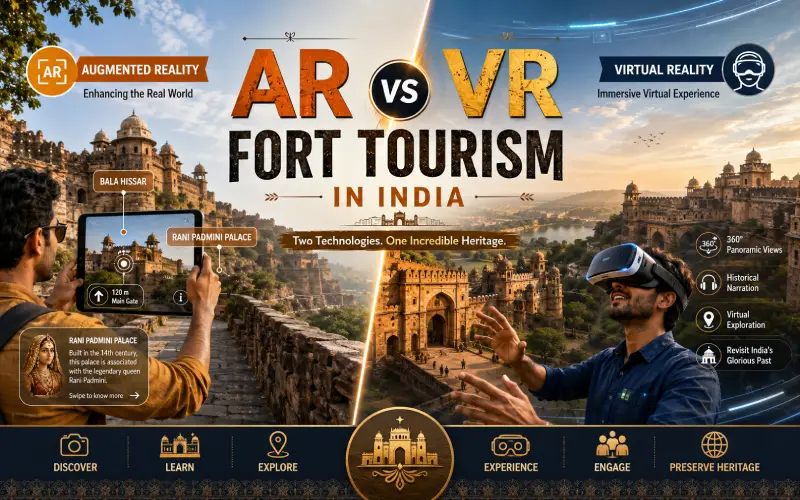
Although AR and VR are often discussed together, they provide very different tourism experiences. AR adds digital information to the physical world, while VR places users inside a completely virtual environment.
Understanding AR vs VR in tourism can help travellers, tourism departments, museums, heritage organisations, and technology developers select the right solution. For those interested in exploring India’s cultural heritage, our guide to famous forts in India introduces remarkable historical destinations that can be experienced physically or through immersive technology.
We are here to explain both technologies clearly.
AR and VR are transforming how people discover destinations, explore historical monuments, and learn about cultural heritage. These technologies make tourism more interactive, accessible, educational, and engaging for visitors of all ages.
This comparison focuses on a few important factors:
- Real-World Interaction: How each technology connects digital content with physical tourist locations.
- Accessibility: Whether users need to travel to the destination or can explore it remotely.
- Immersion: How effectively the technology makes visitors feel connected to the destination.
Let us explore the differences, advantages, and practical applications of AR and VR in modern tourism.
1. Augmented Reality: Enhancing the Real Tourism Experience
Best for: Travellers physically visiting monuments, forts, museums, and heritage destinations.
Platform: Smartphones, tablets, and AR-enabled glasses
Augmented Reality adds digital elements such as text, images, animations, directions, historical reconstructions, and 3D objects to the visitor’s real-world surroundings.
Why it is useful in tourism: Visitors can point their mobile camera at a monument and instantly view historical information, architectural details, navigation instructions, or a digital reconstruction showing how the location appeared in the past.
Our Verdict: AR is ideal for improving an actual visit because it provides useful and interactive information without disconnecting tourists from the physical destination.
2. Virtual Reality: Exploring Destinations from Anywhere
Best for: Virtual tourism, destination previews, education, accessibility, and remote exploration.
Platform: VR headsets, smartphones, computers, and 360-degree applications
Virtual Reality places users inside a digitally created or 360-degree environment. It allows people to explore forts, monuments, museums, and tourist destinations without being physically present at the location.
Our Verdict: VR is an excellent solution for immersive virtual tours, educational experiences, travel planning, and providing access to destinations that may be difficult to visit physically.
3. AR vs VR: Understanding the Main Difference
Best for: Understanding which immersive technology is suitable for a tourism project.
Platform: Mobile devices, computers, AR systems, and VR headsets
AR enhances the existing physical environment by placing digital information over it, while VR replaces the real environment with a fully virtual experience. AR generally supports visitors during an actual trip, whereas VR allows users to experience destinations remotely.
Our Verdict: AR is better for enhancing on-site tourism, while VR is better for immersive remote exploration and virtual destination experiences.
4. AR and VR for Fort and Heritage Tourism
Best for: Forts, monuments, museums, archaeological sites, and cultural tourism.
Platform: Tourism applications, interactive displays, smartphones, and VR devices
AR can display historical characters, battle information, architectural reconstructions, and navigation guidance during a physical fort visit. VR can recreate inaccessible sections, provide complete 360-degree fort tours, and transport users into important moments from history.
Our Verdict: Both technologies can make fort tourism more informative, interactive, and memorable while helping preserve and promote historical heritage.
5. Combining AR and VR in Tourism
Best for: Tourism departments and heritage organisations seeking a complete digital experience.
Platform: Integrated mobile applications, visitor centres, museums, and immersive installations
AR and VR do not need to compete with each other. Tourism projects can use VR to help travellers preview a destination before visiting and AR to guide and educate them after they arrive.
Our Verdict: Combining AR and VR creates a complete tourism journey that supports inspiration, planning, exploration, education, and post-visit engagement.
How to Choose the Right Technology for Tourism
- On-Site Information and Navigation: Augmented Reality
- Remote Destination Exploration: Virtual Reality
- Interactive Museum or Heritage Experience: AR and VR
- Virtual Fort Tours and Travel Previews: Virtual Reality
Frequently Asked Questions (FAQ)
About AR and VR in Tourism
- AR adds digital information to the real environment, while VR creates a fully immersive virtual environment.
- AR is commonly used for on-site navigation, historical information, and interactive monument experiences.
- VR is commonly used for virtual tours, destination previews, heritage education, and remote tourism.
- Both technologies can help tourism organisations promote destinations and improve visitor engagement.
Using Immersive Technology for Fort Tourism
- AR can guide visitors through a fort and display historical information at important locations.
- VR can provide immersive 360-degree fort tours for users who cannot physically visit the destination.
- Combining AR and VR can create a complete experience before, during, and after a tourist visit.
The Future of Tourism Is Immersive
AR and VR are creating exciting opportunities for travellers, tourism departments, museums, educators, and heritage organisations. Whether the goal is to enhance a physical visit or offer a complete virtual journey, both technologies can make tourism more accessible and engaging.
To continue exploring India’s historic forts and understand how immersive technology can support heritage tourism:
Experience history beyond photographs and traditional guides with the power of Augmented Reality and Virtual Reality tourism.
▲
